
By SPEER Intern, Vaishnavi Kharade
Heat as a Public Health Crisis
Texas summers have always been hot, but recent years have shown us something different: record-breaking heatwaves that last for weeks. In 2023, triple-digit temperatures and dangerous heat indices tested our communities, power grid, and public health systems.
While emergency cooling centers and hydration campaigns grab headlines, a quieter, long-term strategy deserves more attention: energy efficiency. By making our homes and buildings more efficient, we reduce grid stress, lower bills, and most importantly keep Texans safer during extreme heat.
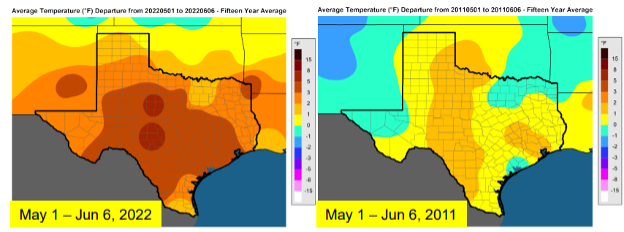
Photo credit: ERCOT (Electric Reliability Council of Texas: 2022 Summer Weather Update (Item 7.1, Page 14)
The maps above tell an important story. On the left, we see early summer in 2022, where much of Texas is shaded in dark orange and red — colors that indicate temperatures far above the long-term average. In fact, by early June, Texas was already running 5–10°F hotter than normal across a large portion of the state. On the right, the same period in 2011 looks far less alarming, with much of the state closer to average or even slightly cooler. And yet, 2011 went on to become one of the most extreme heat waves in Texas history.
That comparison matters. If 2022 was already starting off hotter than 2011, it raised serious concerns that the summer could once again test the limits of Texas communities and its electric grid. ERCOT warned at the time that 2022 was likely to rank among the top 10 hottest summers on record.
This side-by-side view is more than just weather trivia, it highlights how quickly conditions can escalate when high heat combines with drought and limited rainfall. What begins as an “early anomaly” can turn into a prolonged crisis that pushes energy systems, infrastructure, and people to their limits.
Why Energy Efficiency Matters in Extreme Heat
When the temperature spikes, air conditioners across Texas run at full blast, driving up electricity use and putting enormous strain on the grid. According to ERCOT, nearly half of the state’s summer electricity demand during peak load times come from the residential sector, and most of that is tied directly to cooling homes. On the hottest afternoons, when millions of AC units kick on at once, demand can skyrocket to dangerous levels. This was evident in 2011, when record-breaking heat forced ERCOT to order rolling blackouts in some areas to keep the grid from collapsing. Similar warnings were issued in 2022, as triple-digit heat pushed demand close to all-time highs, and again during the summer of 2023 when ERCOT issued numerous voluntary conservation calls and set 11 new peak demand records due to extreme heat and tight grid conditions. These moments show how quickly the system can reach its breaking point.
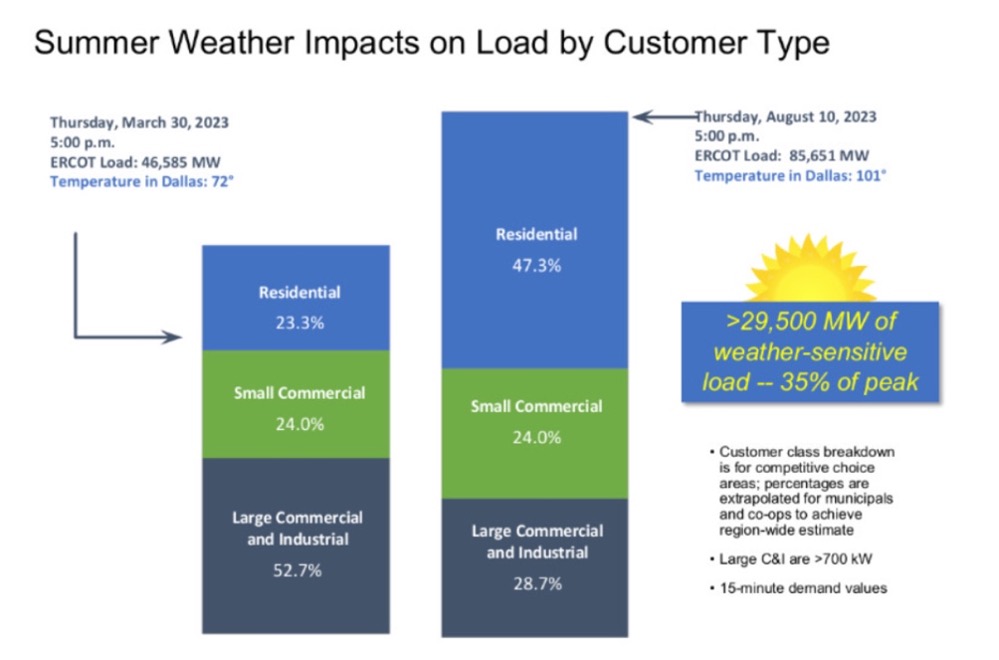
Energy efficiency helps in three key ways:
- Reduces cooling loads – Homes and businesses need less energy to stay cool with better insulation and efficient HVAC systems.
- Lowers peak demand – Efficiency upgrades ease pressure on the grid during the hottest hours. A Texas A&M study from 2024 shows Texas can reduce peak demand by over 11GWs with heat pumps.[1] Lower demand, often means lower electricity costs.
- Protects residents indoors – Energy-efficient homes maintain safer indoor temps longer, even during outages.
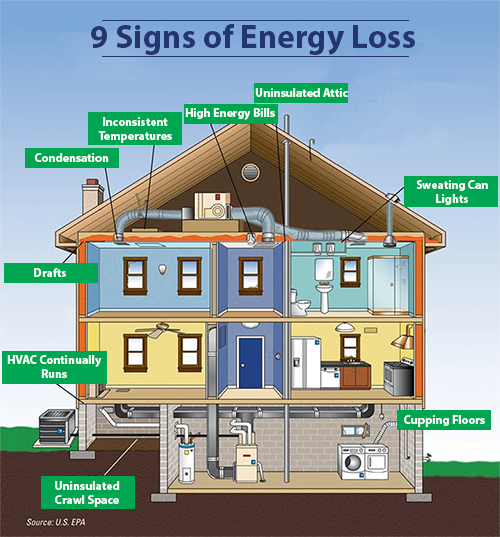 Photo credit: Energy One America
The Public Health Connection
Extreme heat is not just uncomfortable, it is the deadliest weather-related hazard in the U.S. In Texas, vulnerable populations, often seniors, young children, and people with chronic illnesses, are hit hardest. These outages can be exacerbated by the impact of other severe weather events that Texas experiences like hurricanes, tornadoes, and flooding. However, energy efficiency can function as a health intervenor. Efficient cooling reduces asthma and respiratory flare-ups, while adequate insulation and proper duct sealing keep homes comfortable and safer during outages. In addition, lower energy bills prevent families from sacrificing cooling for essentials such as food or medicine.
Policy and Program Opportunities in Texas
Texas has efficiency programs in place, but improvements are needed to scale up and meet the heat challenge.
- Stronger Building Codes: Texas follows the 2015 International Energy Conservation Code (IECC) with some amendments, which sets minimum efficiency standards for new construction. However, these standards lag far behind states that have adopted more current codes standards, such as the 2021 or 2024 IECC. Cities and counties have the authority to adopt stronger codes beyond the state minimum, requiring better insulation, more efficient HVAC systems, and heat-resilient construction practices. Local governments that take this step can provide long-term benefits for residents by lowering cooling costs, easing strain on the grid, and keeping homes safer during extreme heat events. It is worth nothing that Texas should be moving to the 2024 IECC as the statewide baseline prior to the end of 2025. The Energy Systems Lab at Texas A&M has passed along their recommendations for code adoption to the State Energy Conservation Office (SECO), which will trigger the process to move to an updated code.
- Utility Programs: Incentives for efficient HVAC units, smart thermostats, and home energy audits to show where leaks exists and cool air is escaping the building can reduce household costs and grid strain.
- Weatherization Assistance Expansion: Federal and state funds can prioritize heat-vulnerable households, especially in older housing stock.
- Local Government Leadership: Cities and counties can retrofit municipal buildings, saving taxpayer money while modeling resilience.
Reaching Those Most at Risk
Efficiency benefits often don’t reach the people who need them most, such as low-income households, renters, and communities of color. Strategies to reach these individuals, which often experience high energy burdens, could include incentivizing landlords to upgrade rentals with solutions that address split incentives, providing tailored outreach to diverse communities, and prioritizing low-income funding. By assisting those with high energy burdens, efficiency programs can reduce health disparities and protect Texans most vulnerable to heat.
A Vision for Texas: Efficiency as Resilience Infrastructure
Imagine a future where every Texas home is properly insulated, every public building is energy-smart, and every community faces lower risk during heatwaves. In this vision, energy efficiency is not just about saving kilowatts, it becomes core resilience infrastructure.
Energy efficiency:
- Saves households money through reduced energy bills, year after year. This provides consumers with more disposable income from these savings, and this additional money in Texans’ pockets can be put into the local economy or towards other necessities, like food and medicine, which a growing number of consumers are often faced with having to make a trade off decision between these items.
- Protects residents when the grid is stressed, keeping indoor environments comfortable and safer for longer.
- Boosts grid resiliency by lowering demand often impacted by energy consuming air conditioning, with simple measures such as better insulation, high-performance windows, efficient HVAC systems, LED lighting. Every megawatt of demand avoided is a megawatt the grid doesn’t have to generate or transmit.
But efficiency is more than mechanical systems and insulation. Natural and passive solutions, like expanding tree canopy coverage, designing cool and reflective roofs, and using heat-resistant building materials, complement traditional upgrades. Research shows that tree canopy can reduce neighborhood air temperatures by as much as 5–9°F, a difference that can save lives during heatwaves. These measures cool neighborhoods, reduce the urban heat island effect, and provide shade that lowers reliance on air conditioning. Together, they create a multi-layered shield that makes homes and communities more livable in extreme heat.
This should not be viewed as a distant dream. It’s a practical resilience strategy that Texas can implement today, both an investment in public health and long-term affordability.
From Awareness to Action
Extreme heat is here to stay. But Texas has a powerful defense: energy efficiency as a lifeline. By investing in weatherization, adopting and implementing updated building codes, expanding access to efficiency programs, and pairing them with natural solutions like shade trees and cool roofs, the state can protect lives, strengthen resilience, and lower costs.
Energy efficiency, especially when reinforced by smart building design and nature-based solutions, is Texas’s first line of defense against extreme heat. By lowering demand at the source, efficiency reduces strain on the grid, keeps homes and businesses cooler, and protects vulnerable residents during dangerous heat waves. But efficiency is more than just a shield, it’s also a force multiplier. Every kilowatt-hour saved amplifies the impact of new supply-side investments, stretching limited resources further and buying valuable time. In this way, energy efficiency acts as a “bridge” solution for Texas while the state evaluates how to expand and diversify its energy supply over the next 5–10 years. Efficiency measures can deliver immediate relief, cost savings, and resilience benefits.
[1] https://interchange.puc.texas.gov/Documents/38578_135_1432200.PDF