
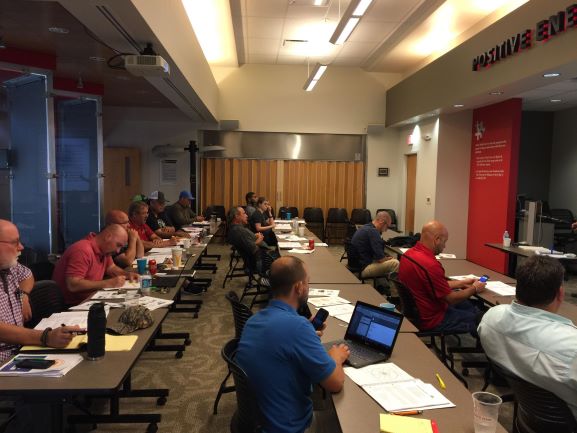
BOC Level I Training Certificate of Completion (TCOC) is earned by attending 8 days of (non-consecutive) technical class training, completing tests, and performing energy-efficiency project assignments focused on the participant’s actual facility. Focus areas of the 72 hours of classroom training include HVAC systems and controls, lighting, energy benchmarking, indoor air quality, facility and electrical systems and systems operations/maintenance. After successfully completing the training program and earning your TCOC, you are eligible to sit for the Certification Exam and earn the title of Certified Building Operator, adding another valuable credential to your resume. Learn more about the certification exam to become a Certified Building Operator (CBO).
Level I Courses
1001 – Energy Efficient Operation of Building HVAC Systems
1002 – Measuring and Benchmarking Energy Performance
1003 – Efficient Lighting Fundamentals
1004 – HVAC Controls Fundamentals
1005 – Indoor Environmental Quality
1006 – Common Opportunities for Low-Cost Operational Improvement
Continuing Education Hours Offered by:
- American Hotel & Lodging Association (AH&LA)
- Building Owners and Managers Institute (BOMI)
- Cal State University San Marcos
- National School Plant Management Association (NSPMA)
Green Building Certification Institute (GBCI)
The Green Building Certification Institute (GBCI) has approved the core BOC Level I curriculum for continuing education hours toward the LEED Credential Maintenance Program. 1001 is approved for 16 GBCI continuing education hours, while 1002-1006 are each approved to earn a LEED credential holder 8 continuing education hours. For more information visit our Recognition and Accreditation page.
Level I Course Descriptions
BOC 1001 – Energy Efficient Operation of Building HVAC Systems
In this two-day class, participants will learn about the Building Operator Certification training program and the requirements for demonstrating their knowledge and ability to apply the essentials of effective and energy efficient operations and maintenance. Participants will learn the fundamentals of building systems, including the envelope, heating, cooling, and air and ventilating systems, to be able to understand and relate how those systems interact with each other, the building, the occupants, and the environment.
BOC 1002 – Measuring and Benchmarking Energy Performance
Operators learn how energy is used in commercial buildings and how to identify and prioritize conservation opportunities. Includes basic principles of energy accounting, evaluation of fuel options, operation and maintenance strategies to improve efficiency, and energy management planning techniques. Participants will learn how to perform quantifiable evaluations of their facilities’ energy use in order to be able to target prospects for energy conservation.
BOC 1003 – Efficient Lighting Fundamentals
Covers lighting fundamentals and types of lighting for economical and energy efficient lighting systems. Participants learn principles of efficient lighting including evaluation of lighting levels, quality and maintenance. Other topics include lighting fixture and control technologies, common upgrades, retrofit and redesign options, and management strategies as they apply to space use and function.
BOC 1004 – HVAC Controls Fundamentals
Provides an introduction to automatic control systems and equipment, particularly for central air systems. Participants will learn to target possible inefficiencies in their HVAC systems and to evaluate potential problems as part of an enhanced operation and maintenance program. Students will be introduced to the fundamentals of automatic control systems for building mechanical systems to target possible inefficiencies in their HVAC systems and to evaluate potential problems as part of an enhanced operation and maintenance program.
BOC 1005 – Indoor Environmental Quality
Introduces the basic causes of indoor environmental quality problems and begins to develop a method of diagnosis and solution. Students will gain an understanding of the dynamic components of indoor environmental quality in relation to source control, occupant sensitivity and ventilation. Emphasis will be placed on communications with building occupants for reliable investigations without aggravating existing issues.
BOC 1006 – Common Opportunities for Low-Cost Operational Improvement
This class introduces common opportunities that offer the greatest energy savings potential. This module examines typical areas and problems associated with different system types and equipment as well as tools and techniques for identifying opportunities.
SUPPLEMENTAL COURSES (1 offered per course series)
BOC 1007 – Facility Electrical Systems
Participants are taught basic electrical theory, safety procedures, power distribution, and energy conservation to develop a practical understanding of electricity and its use in commercial facilities. Participants will learn basic troubleshooting in order to effectively work with licensed staff and/or contractors with ongoing electrical problems and maintenance support.
BOC 1008 – Operation & Maintenance Practices for Sustainable Buildings
In this class participants are taught O&M best practices for green or high performance buildings including exterior site issues, water efficiency, cleaning products, material and supply purchasing, energy, and indoor environmental quality to improve the performance of both existing buildings and newly-designed green buildings.
BOC 1009 – Building Scoping for Operational Improvement
Students learn hands-on information gathering and analysis and create a prioritized scope of work for finding opportunities for energy saving operational adjustments to plan a building tune-up project. Participants will be required to work through an e-learning module prior to attending the class.
BOC 1010 – Energy Efficient Ventilation Strategies and High Performance Heating and Cooling Equipment
This class introduces the theory, design, and operational practices for displacement ventilation strategies, underfloor air distribution systems, and naturally ventilated and mixed mode strategies in buildings to improve thermal comfort, reduce system energy use, and maintain an effective and high-performing ventilation system. Participants will learn the theory, design, and operational practices for new HVAC equipment technologies being installed in high performance buildings, so they can calculate the total cost of ownership, help building owners comply with energy codes, and meet building energy management goals.
BOC 1011 – Energy Efficient Ventilation Strategies and Energy Savings through Energy Recovery
Participants are taught the theory, design, and operational practices for displacement ventilation strategies, under-floor air distribution systems, and naturally ventilated and mixed mode strategies in buildings to improve thermal comfort, reduce system energy use, and maintain an effective and high-performing ventilation system. Participants will learn the theory, design and operational practices for energy recovery from air and water source systems to determine applicable methods for capturing heating and cooling energy before it is vented or wasted in their building.
BOC 1012 – High Performance Heating and Cooling Equipment and Energy Savings through Energy Recovery
Students will learn the theory, design, and operational practices for new HVAC equipment technologies being installed in high performance buildings and calculate total cost of ownership to help building owners comply with energy codes and meet building energy management goals. Participants will learn the theory, design and operational practices for energy recovery from air and water source systems to determine applicable methods for capturing heating and cooling energy before it is vented or wasted in their building.
BOC 1013 – Smart Building Fundamentals
As buildings continue to get smarter and evolve, it is becoming ever more challenging to keep up with the technology changes. This class provides an overview of what makes a building smart. Learn about interconnections that can tie together different standalone systems such as HVAC, lighting, power monitoring, and even furnishings and other components. These connections enhance the operational and occupant user experience, saving energy and providing greater comfort. Concepts discussed include networking, security, systems integration, analytics, and operational strategies